JIMIN CHOI
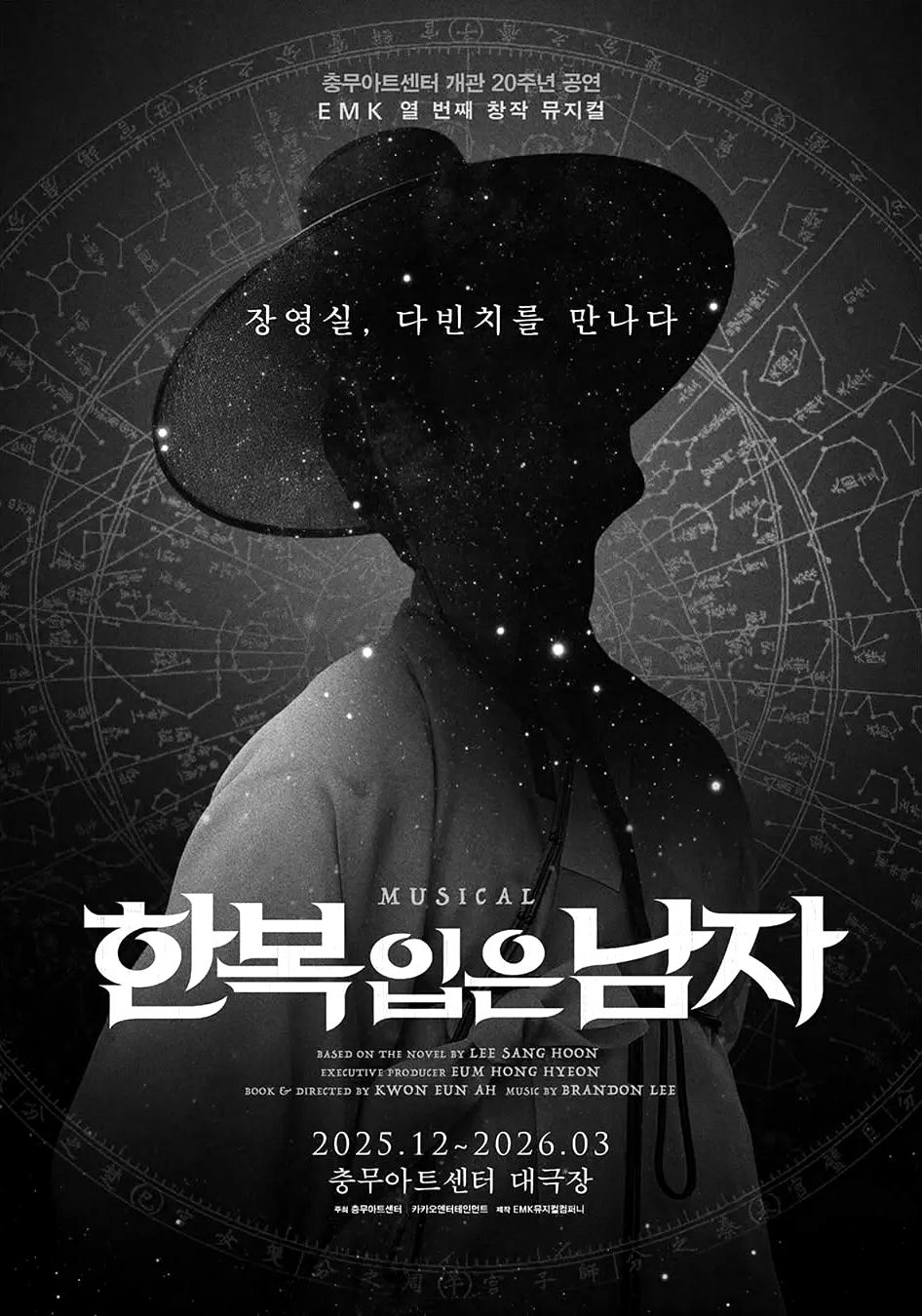
© EMK Musical Company / Man in Hanbok (2025)
EMK's Quietest Spectacle Yet?
MAN IN HANBOK
EMK Musical Company has long been synonymous with grandeur -- the kind that glows beyond the red velvet curtains and echoes through gilded theatres. Their works (Mozart!, The Man Who Laughs, Beethoven; Secret) are rarely about restraint. They thrive on scale. But, with Man in Hanbok, EMK seems poised to turn that grandeur inward.
Billed as the company’s tenth original musical, Man in Hanbok revisits one of Korea’s most compelling historical figures: Jang Yeong-sil, the Joseon-era inventor and scientist who revolutionised timekeeping and astronomy.
Yet this is far from a simple museum piece. The show’s tagline -- “Jang Yeong-sil meets Da Vinci” -- hints towards something bolder: a thought experiment that collapses continents and centuries to explore the life of an exiled genius.
THE PRICE OF GENIUS
Born into the lowest social class as a nobi, Jang Yeong-sil’s ascent was near impossible. But King Sejong (the visionary monarch behind the creation of the Korean alphabet) saw value where society saw none. With the King’s patronage, Jang went on to design water clocks, sundials, and celestial instruments that would redefine Korea’s understanding of time.
Theirs was said to be a bond deeper than that of king and subject: a friendship built on curiosity and trust. But genius often provokes unease. Jang’s closeness to Sejong stirred resentment in court, and in 1442, when a royal palanquin he engineered broke during the King's procession, his enemies pounced. He was stripped of favour and erased from the record. What followed was silence, into which imagination naturally rushes.
That silence is where Lee Sang-hoon’s novel Man in Hanbok begins, and where EMK’s adaptation finds its footing. Inspired by Rubens’ Man in Korean Costume (1671), Lee constructs a bridge between history and speculation: what if the man in Rubens’ sketch was Jang Yeong-sil, living in exile in Europe? What if, hidden from the Joseon court, he met Leonardo da Vinci and became his tutor? Drawing threads from sketches by the two geniuses that bear certain resemblances, Lee’s novel blurs biography and myth, suggesting an invisible lineage of invention that leaps borders and centuries.
This is speculative history at its most daring, as the author fills in the gaps left by time with what could have been. The story imagines encounter not exile, bringing two geniuses together from opposite corners of the world.
A NEW LANGUAGE OF GRANDEUR
For EMK, this adaptation is more than a historical fantasy. It seems to be a statement of intent. Man in Hanbok marks the company’s first production created entirely by a Korean team, a symbolic inversion of its own legacy. After years of adapting European mega-musicals, EMK now seems ready to export rather than import -- to position Korean imagination as the source, not the echo.
Visually, the show promises the splendour audiences expect: flowing hanbok silhouettes set against celestial maps and Joseon architecture bleeding into Renaissance light. It’s spectacle, yes, but spectacle with purpose. Where Beethoven; Secret reframed Western music through a Korean lens, Man in Hanbok is setting its sights on reversing the gaze, offering Korea’s own heritage as the origin point of innovation.
When Man in Hanbok opens, expect EMK’s signature opulence, but perhaps its quietest success will be this -- turning a forgotten silence into song.